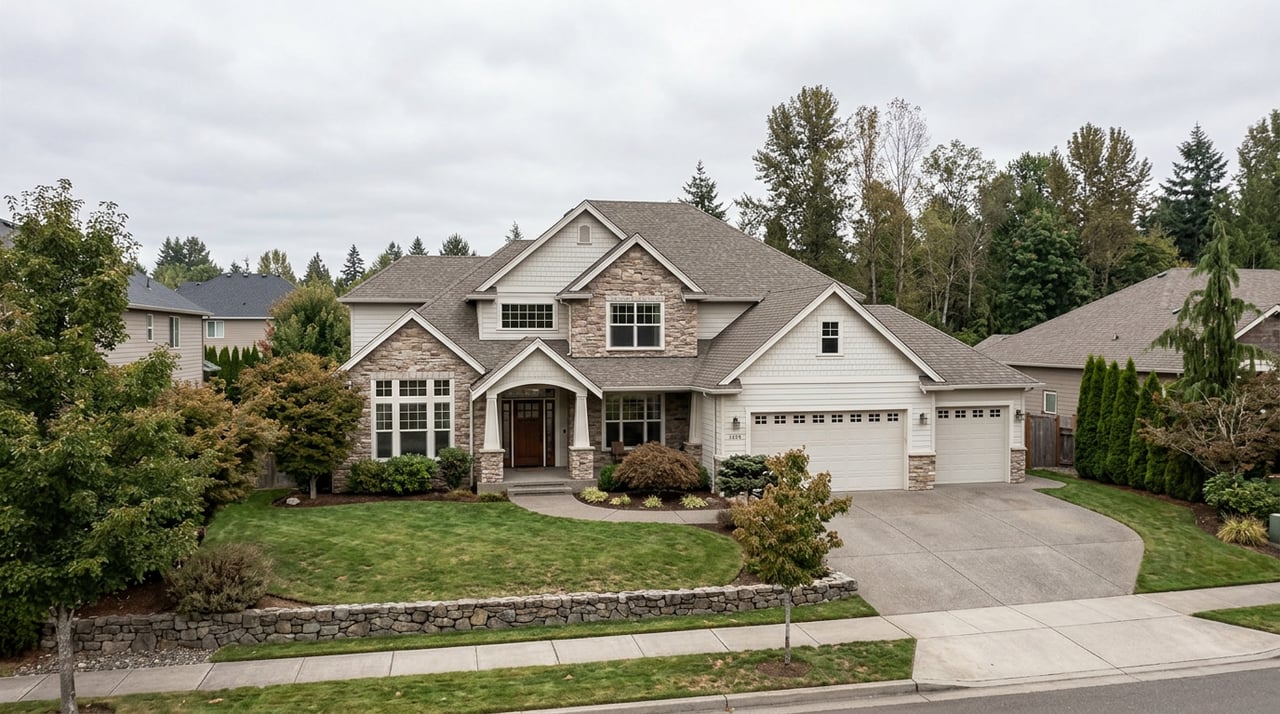
Pull up any of the big listing sites this month and you'll see the same headline number for Littleton: a median home price hovering around $625,000 to $630,000, softer than a year ago by anywhere from roughly 1 to 4 percent depending on which dataset you trust. Zillow's home value index puts the decline at 4.2 percent as of July 2026. Houzeo's tracker shows a gentler 1.18 percent drop. A separate analysis of Zillow's underlying ZHVI data pegs the median at $628,722 in February 2026, down 2.6 percent from a March 2025 peak of $645,694.
Look only at Historic Downtown Littleton, and the story flips. Local market coverage in mid-2026 put the downtown median at $725,000, up 20.8 percent year over year. That is not a rounding difference. That is two markets wearing one name tag.
If you are comparing Littleton to other Denver-metro suburbs, the citywide number is the one you keep seeing, and it is not wrong. It is just incomplete. The real question for anyone buying or selling here right now is which Littleton you are actually looking at, and the answer has less to do with charm or school zones than with a 63-acre construction site most people only know as "the place getting the Costco."
The City Is Not Shrinking Evenly, and Neither Is the Market
Littleton's population has been essentially flat to slightly down over the past several years, an unusual pattern for a Denver-area suburb where most neighbors are still adding residents. Softer population growth tends to mean softer aggregate demand, and that shows up in the citywide median: fewer buyers competing for a fairly fixed supply of older housing stock pushes prices sideways or down.
But a flat population doesn't mean a static one. It means people are moving within the city, not just into or out of it, and the destinations they're choosing are not random. Zip-code data shows just how wide that internal spread has become. The cheapest corners of Littleton, ZIP codes 80128 and 80123, sit at roughly $592,000. The priciest, 80125, runs closer to $724,000. That is a gap of more than $130,000 inside a single city of about 45,000 people, and it has been widening, not narrowing.
A citywide median blends all of that into one number. It tells you almost nothing about what a specific block, or a specific mile, is actually doing.
What's Actually Pulling Downtown Up
Historic Downtown Littleton's premium is not mysterious. It's a small, walkable core with a light rail station, a merchants association that runs a monthly Wine Walk from May through September, and a business district that has been filling in with new retail and food service through 2026, from an expanded Dirt Coffee location to new boutique and banking storefronts along Main. Walkability and an active street-level scene command a price in almost every metro, and Littleton's downtown has both in a way most of the rest of the city doesn't.
That premium was already forming before this year. What's newer, and what deserves more attention from anyone shopping the broader Littleton market, is what's happening about a mile and a half away on the city's west side.
Since 2025, crews have been clearing the former Lumen Technologies office campus at 700 W. Mineral Ave., a 63-acre site Republic Investment Group bought for $50 million. The project, called Mineral Place, is anchored by a roughly 160,000-square-foot Costco with a 32-pump fuel station, expected to open sometime in 2026, alongside a second big-box tenant still to be announced and nine smaller retail pads. A 370-unit apartment community called The Sullivan, developed by San Antonio-based Embrey, is going in on an adjacent parcel, with first units expected in fall 2026 and full completion roughly a year after that.
The city isn't quiet about what it expects this to do. Brian Garner, Littleton's economic development manager, told 9News the redevelopment will function as an economic engine for the city, calling it, in his words, "the biggest project that Littleton has seen in probably decades." The numbers behind that claim are specific: the site is projected to generate about $2.8 million in annual net sales tax revenue in its first year, rising to roughly $9 million by year ten, along with more than 800 permanent jobs once the retail spaces are fully leased.
That is the kind of investment that tends to lift a submarket over time, not instantly, but durably: better retail access, new rooftops from The Sullivan feeding foot traffic to the smaller pads, a signalized intersection improvement at West Mineral Avenue built partly to serve nearby schools like Littleton Academy and the Primrose School of Littleton. None of it shows up in this month's median. Most of it shows up over the next two to five years, the way Historic Downtown's premium built over a longer runway than a single season.
Reading the Map Instead of the Median
If you're comparing Littleton to other West Denver or Jeffco suburbs on price alone, the citywide figure will undersell what's happening near downtown and oversell what's happening in parts of the city with no comparable catalyst. If you're specifically weighing a home near the Mineral corridor, the calculation is different again: you are buying ahead of an amenity that doesn't fully exist yet, at a price that hasn't caught up to what a completed Costco-anchored district with hundreds of new apartment residents tends to do to nearby retail and resale demand.
Neither position is automatically the smarter one. They're just different bets, and knowing which bet you're placing matters more than knowing the citywide median.
A few practical distinctions worth making before you get further into either search:
- A home priced against "the Littleton median" without noting its ZIP code is being priced against a number that doesn't describe any specific block in the city.
- Proximity to Historic Downtown already carries most of its premium in current asking prices. You are paying for an established amenity, not betting on a future one.
- Proximity to Mineral Place is closer to the second scenario Littleton went through with its downtown years ago: the infrastructure is real and funded, but the price adjustment tends to lag the construction timeline, sometimes by a year or two after an anchor tenant actually opens its doors.
For sellers near either pole, that means the comp you lean on should come from inside your own ZIP code and, ideally, from sales in the last two quarters rather than a trailing twelve-month average that predates recent shifts. For buyers, it means asking your agent to walk the actual sold comps within half a mile before accepting a citywide number as a starting point for negotiation.
A Few Questions Worth Asking Before You Commit
Does a falling citywide median mean Littleton is a weak place to buy? Not on its own. It means demand is uneven across the city, which is different from demand being weak everywhere. The submarkets tied to real investment, downtown and increasingly the Mineral corridor, are behaving very differently from the citywide blend.
Will home values near Mineral Place jump the moment Costco opens? Based on how these things typically unfold, expect the value shift to build over the following one to two years as the apartment community fills, the smaller retail pads lease up, and the traffic and sales tax data start showing the district actually functioning day to day, not just the week ribbon-cutting happens.
How do I find out which Littleton I'm actually looking at? Start with the ZIP code, then the comps inside it, not the citywide figure. A property two ZIP codes apart from the one you're comparing it to is being measured against the wrong baseline.
Littleton right now is a city where the headline number and the neighborhood reality have quietly come apart. Anyone shopping the market on the citywide median alone is negotiating with a number that doesn't apply to the property in front of them.
If you're trying to figure out which side of that split a specific Littleton address falls on, or want a straight read on how a home near Mineral Place or Historic Downtown is actually pricing right now, Brian K. Grace has spent his career in these West Denver and Jeffco submarkets and can walk the comps with you block by block. Call Brian. Start with a conversation about your home.
